Pneumatic Automation Overhaul for a Bottling & Packaging Line
Case Study

Pneumatic Automation Overhaul for a Bottling & Packaging Line

How a UAE-based beverage manufacturer eliminated production bottlenecks and reduced energy costs through a redesigned pneumatic actuation system.

Food & Beverage Manufacturing Jebel Ali, Dubai, UAE
35% Faster Cycle Time
42% Less Downtime
28% Energy Saved
6 Mo ROI Payback

Aging Pneumatic Infrastructure Stalling Production Targets

The facility operated a high-speed bottling line running approximately 18 hours per day across three shifts. Over the course of five years, the pneumatic actuation system—responsible for bottle clamping, cap placement, label application, and carton sealing—had degraded significantly. Operators were reporting frequent misfires in the clamping cylinders, inconsistent label placement, and regular air leaks across the main distribution manifold.

Unplanned downtime had increased to an average of 3.2 hours per week, directly impacting throughput. The existing system used a patchwork of components from multiple suppliers with no standardized sizing, and the air preparation units (FRLs) were either bypassed or clogged. Compressed air consumption had risen to approximately 1,400 CFM—well above the 1,000 CFM the compressor was rated for—leading to pressure drops during peak demand.

The client needed a complete pneumatic system audit and redesign that could be implemented during a planned two-week shutdown, with minimal risk to the restart timeline.

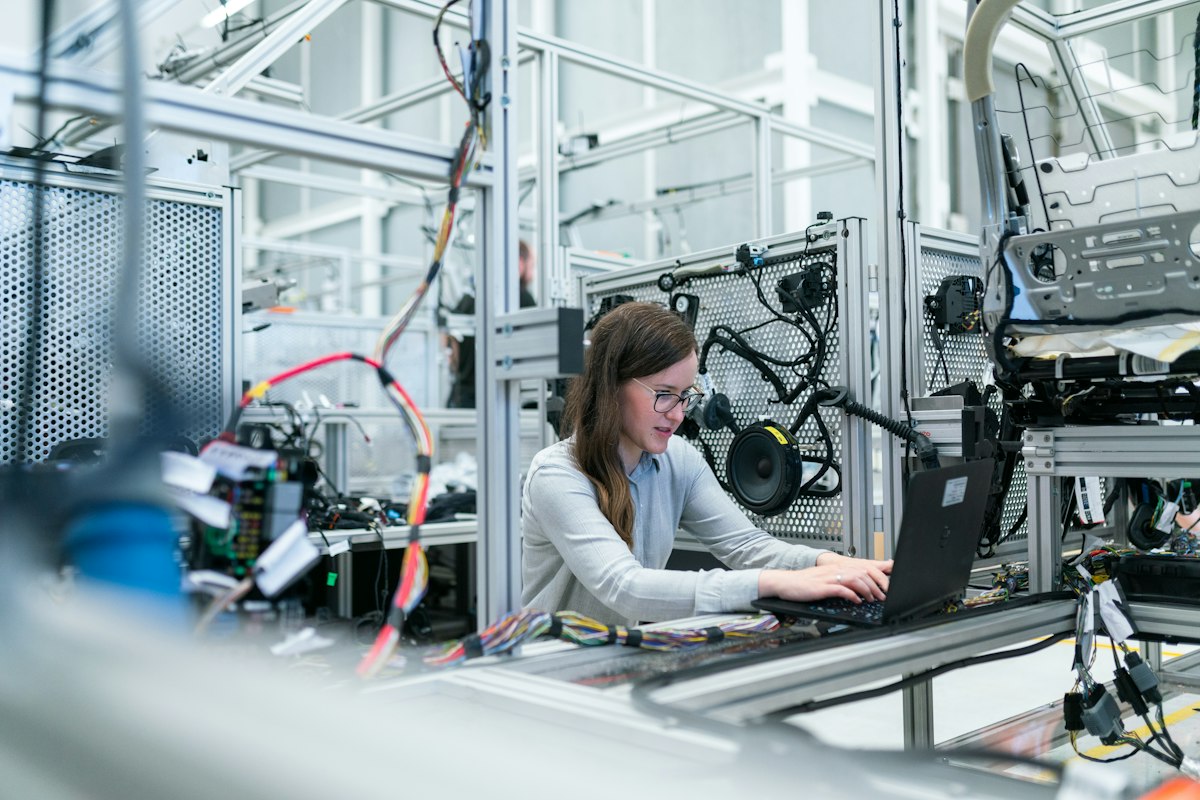
Pneumatic cylinders and actuators on automated production line

Compact pneumatic cylinders installed at bottle clamping stations along the high-speed conveyor

Standardized Pneumatic Redesign with Energy-Efficient Components

The engineering team conducted a full pneumatic audit covering 42 actuation points across the bottling line. Each cylinder was assessed for bore size, stroke length, operating pressure, and duty cycle. Air leak detection was performed using ultrasonic scanning, identifying 17 significant leak points—primarily at quick-connect fittings and aging polyurethane tubing.

The solution involved replacing all actuators with SMC CQ2 compact cylinders and CM2 round-body cylinders, selected specifically for each station's force and stroke requirements. The 5/2-way solenoid valves were upgraded to SMC SY series manifold-mounted valves, reducing the number of individual pneumatic connections and simplifying maintenance access.

New modular FRL units (SMC AC series) were installed at each zone with automatic drain functionality. The tubing network was completely replaced with color-coded SMC polyurethane tubing sized at 8mm and 6mm OD for main lines and branch circuits, respectively. Each branch line received dedicated speed controllers (SMC AS series) for precise adjustment of cylinder extend and retract speeds.

Pressure switches with analog outputs were installed at key distribution points to enable real-time monitoring of system pressure, feeding data into the plant's existing SCADA interface.

Industrial automation control panel with pneumatic valves

Manifold-mounted solenoid valves with color-coded tubing for simplified maintenance access

Measurable Gains in Throughput, Uptime, and Energy Efficiency

Following the two-week installation and a three-day commissioning phase, the pneumatic system was brought online and tested under full production load. The results were documented over a 90-day monitoring period.

Cycle time at the capping and labeling stations improved by approximately 35%, with the new speed controllers enabling fine-tuned piston speeds that matched the conveyor rate without overshoot. Compressed air consumption dropped to approximately 940 CFM—a 28% reduction from the previous 1,400 CFM—primarily due to the elimination of leaks and the use of properly sized cylinders that did not require excessive pressure to operate.

Unplanned downtime decreased from 3.2 hours to under 0.8 hours per week. The manifold-mounted valve configuration reduced component count by roughly 30%, making troubleshooting and valve replacement significantly faster. Maintenance staff reported that the color-coded tubing system alone cut diagnostic time in half.

The total project cost was recovered within six months through energy savings and increased output alone.

Beverage manufacturing bottling line automation

Fully commissioned bottling line operating at design speed after pneumatic system overhaul

Standardized Pneumatics as a Competitive Advantage

This project demonstrates a principle that holds across most manufacturing environments: pneumatic systems degrade incrementally, and because each individual failure seems minor, facilities tend to address them reactively. By the time overall system performance is visibly impaired, the cumulative efficiency loss is substantial.

A structured approach—auditing every actuation point, standardizing on a single supplier's component family, sizing components to actual requirements rather than inherited specifications, and adding pressure monitoring—transforms pneumatics from a maintenance liability into a predictable and efficient subsystem.

For facilities operating pneumatic-intensive processes, this case study illustrates that the ROI on a comprehensive system overhaul is both rapid and quantifiable. The client has since engaged Creative Automation to standardize pneumatic systems on two additional production lines using the same methodology.

Need a Similar Solution?

Our engineering team can design and implement custom industrial automation solutions tailored to your requirements.